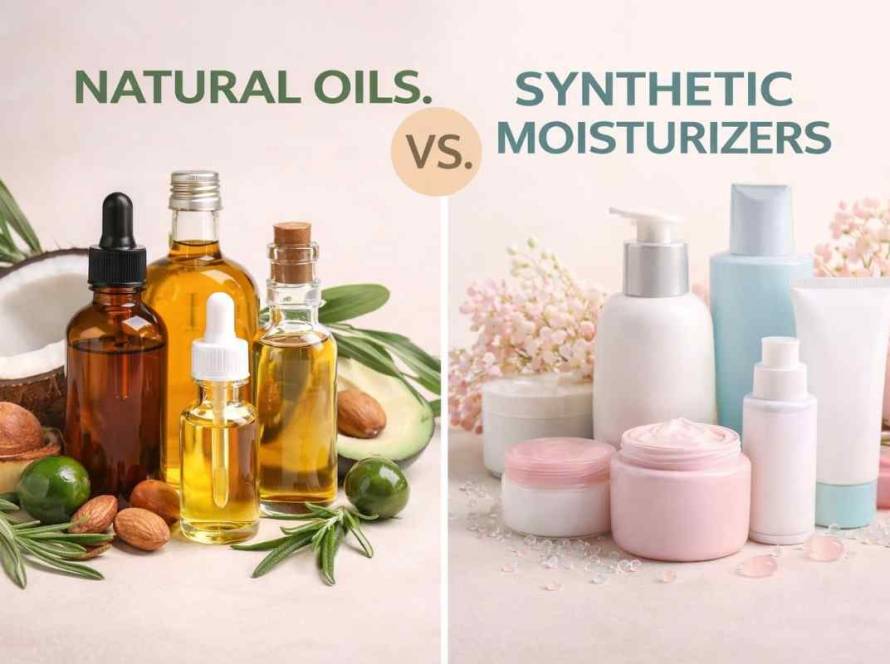
The diet gets blamed. The pillowcase gets blamed. The stress gets blamed. But the shower and what happens in the five minutes after might be the real accomplice.
Picture this. A long, brutal day. A hot shower that runs about ten minutes longer than planned. That deeply satisfying step out, finally feeling human again. And then, two days later, the chin is a crime scene. Sound familiar? Most people with acne-prone skin have lived this exact sequence and blamed everything except the shower itself.
Hot showers don’t cause acne outright. But there’s a very real, very underexplored connection between heat exposure, what it does to pores in the short term, and what happens in the critical minutes after stepping out. Once that window is understood, the logic behind reaching for a quality salicylic acid cleanser post-shower stops being just skincare advice; it becomes plain biology.
What Hot Water Is Actually Doing To Skin
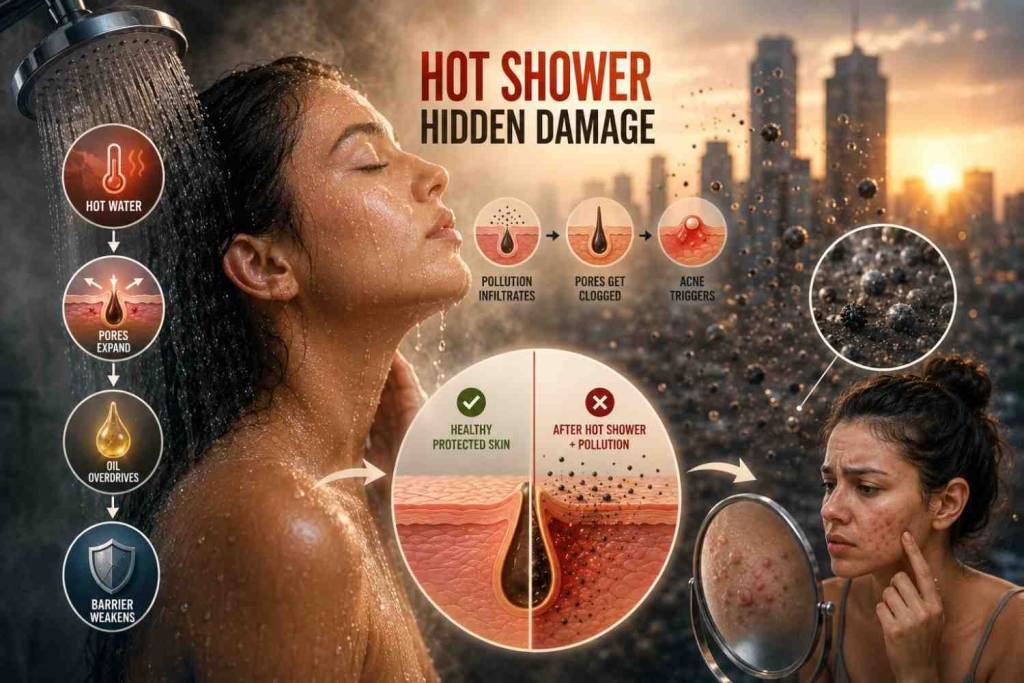
Hot water isn’t just comfortable. It physically changes what’s happening at the skin’s surface. Blood vessels dilate, circulation picks up, and pores those tiny follicular openings, doing a lot of thankless work, temporarily expanding. They’re not “open” the way a door swings open, but they’re significantly less defended than usual. Think of them as ajar.
Hot water can damage the lipid barrier of the skin – the essential protective layer made of ceramides and fatty acids that retains moisture and repels irritants. When that barrier takes a hit, sebaceous glands register it as an emergency and start overcompensating with oil. More oil. Partially open pores. Environmental particles floating in the air. The math isn’t complicated.
In a survey done during 2023, about two-thirds of dermatologists, 67%, pointed out that post-shower pore sensitivity is an often‑ignored acne trigger for adult people, mostly those with oily or mixed skin.
Also, a study that showed up in the Journal of Investigative Dermatology gives support for the direct link between air conditioning, specifically airborne particles, and higher counts of acne lesions. The mechanism is straightforward: particles are opportunistic. When pores are partially open, like right after ten minutes under hot water, infiltration becomes significantly easier. City living makes this worse. Oily skin makes this worse. Doing both and skipping proper post-shower cleansing? That’s stacking the odds against clear skin in a very avoidable way.
The Five-Minute Window That Actually Matters
Most skincare content focuses on what to apply. Almost none of it focuses on when. Timing, especially in the post-shower period, changes what skin can actually do with the products that follow.
When you leave a hot shower, your skin is in a weird midway position; it will be warm, slightly irritated, and have very little oil on it, and due to this, your skin will absorb more than normal. Active ingredients will absorb deep within your skin. Hydration will stay in your skin longer. However, this also works negatively, as anything that you wouldn’t want on/in your skin, like dirt, bacteria, and pore-clogging residues, can easily enter your skin.
That’s why the product choice for this specific window matters far more than most people appreciate. A heavy, comedogenic moisturizer right after a hot shower? Bad call. Skipping cleansing entirely and heading straight to a serum? Also not ideal. What skin is actually asking for in this moment is something that clears the slate without making things worse, which is the precise job of a well-formulated salicylic acid cleanser.
Why Was Salicylic Acid Built For This Situation
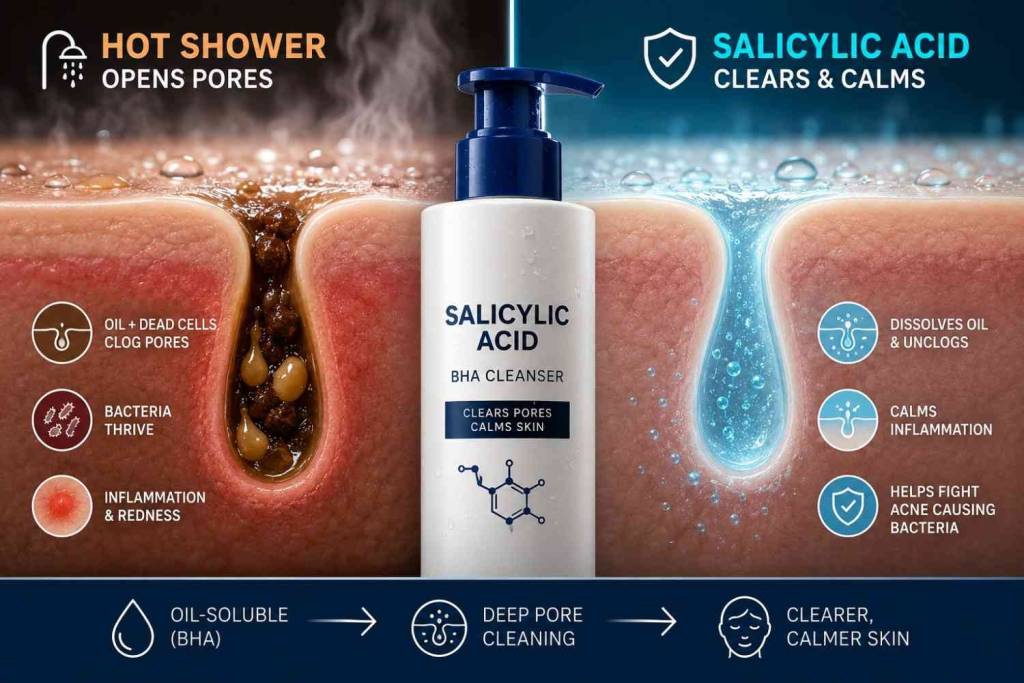
Salicylic acid is a beta-hydroxy acid, a BHA, and unlike AHAs that stay at the skin’s surface, it’s oil-soluble. That oil-solubility is the whole story. Salicylic acid helps dissolve and clear away clogging material (sebum and dead cells) from inside the pore. Because the pores are more open from the heat, there is inherently much more effectiveness from using a salicylic acid product relative to the conditions being adequately timed in conjunction with each other.
Up to 48% fewer Non-inflammatory acne lesions were observed with consistent twice-daily use of 1–2% salicylic acid over 12 weeks, per the American Journal of Clinical Dermatology. Nearly half of blackheads and whiteheads can be addressed by one well-used, well-timed ingredient. Salicylic acid also carries anti-inflammatory properties relevant here because hot water creates surface inflammation that makes skin look red and feel reactive even without active breakouts. A good salicylic acid cleanser used right after the shower quietly handles both at once. (Source)
There’s also a mild antimicrobial effect worth noting. Open, oil-rich pores in a warm, humid post-shower environment are practically ideal conditions for C. acnes bacteria. A targeted anti-acne face wash built around salicylic acid doesn’t give that bacteria much of a welcome window to work with.
Non-Comedogenic Isn’t Just A Buzzword; It’s The Whole Point
Here’s what trips up a lot of people with acne-prone skin. A routine finally gets going. The consistency is there. And the skin still isn’t budging. More often than not, a comedogenic ingredient is hiding somewhere in the stack, something that, while harmless for most skin types, physically blocks pores in acne-prone skin over time.
Coconut oil would be the first ingredient that comes to mind. However, there are plenty of others, like isopropyl myristate, some silicones, cocoa butter, and a few emollients that contribute to this evil. These ingredients are used in formulations for their pleasant sensation and improved texture. After a hot shower, when those pores are already more vulnerable than usual, using anything that isn’t a proper non comedogenic cleanser is actively working against the effort being made.
A genuinely formulated non comedogenic cleanser is built to clean without leaving behind anything that blocks follicles. In combination with salicylic acid, which works to cleanse what’s already there, the effect will be both a shield and an attack. This is how we can truly start making an impact on persistent breakouts.
Post-Shower Cleansing: Water Only vs. Salicylic Acid
| Skin factor | Hot shower, no proper cleanser | Hot shower + salicylic acid cleanser | Research finding |
| Pore blockage risk | High – open pores trap debris | Low – BHA dissolves plugs inside pores | 48% fewer non-inflammatory lesions over 12 weeks |
| Oil overproduction | Elevated – stripped barrier triggers glands | Controlled – zinc + BHA regulates at the source | 87% report reduced oiliness after 4 weeks |
| Bacterial environment | Favourable – warm, oily, open pores | Disrupted – antimicrobial actives reduce load | Measurable lesion reduction within 2–4 weeks |
| Surface redness | Present – heat causes inflammation | Calmed – SA anti-inflammatory action | Visible improvement noted within the first 2 weeks |
| Skin texture | Rough – dead cells accumulate post-shower | Smoother – BHA clears surface buildup | 85% report clearer, smoother skin at 4 weeks |
A Routine That’s Actually Doable
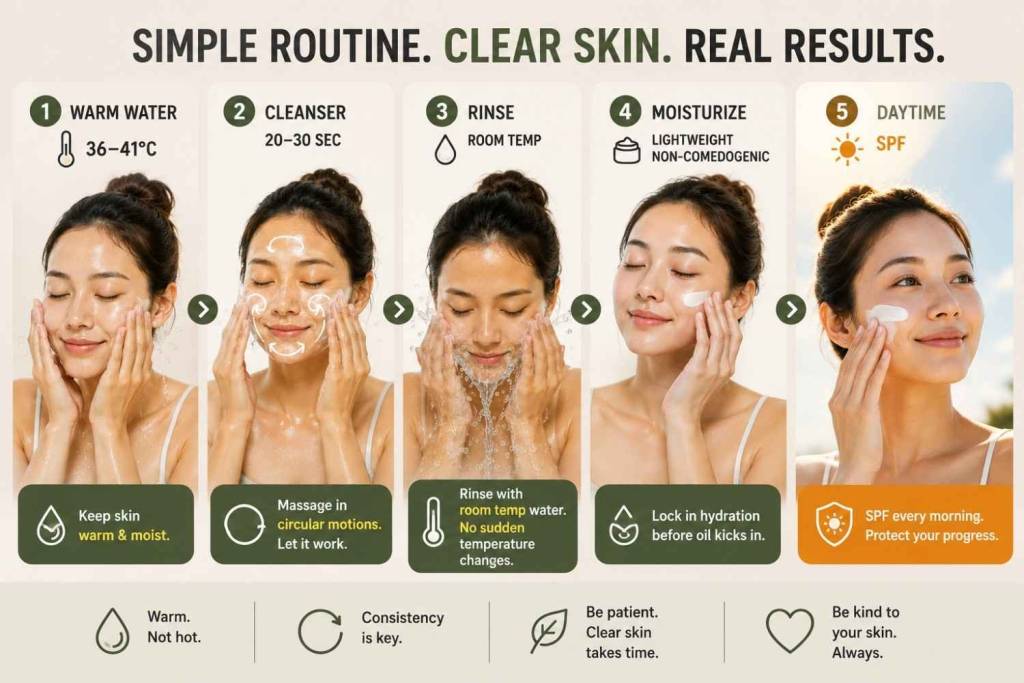
This doesn’t need to be a complicated multi-step production. The simpler the better, honestly – because complicated routines are the ones abandoned at 11 pm when exhaustion wins.
- Drop that temperature a little more. The temperature of any kind must not go beyond 41°C (105°F), as this would destroy the lipid membrane within minutes. This is because it will destroy the lipids inside in a few minutes. The temperature should be quite high but not hot.
- The skin should be kept warm and moist once the cleanser has been applied to the skin..
- That leftover warmth and moisture help BHA slip in more effectively than if you apply it to fully dry skin, honestly.
- Work it in with actual circular motions for 20 to 30 seconds. This is not a rinse and go thing. The acid needs real contact time with the pore lining so it can do its job properly.
- After using room temperature water (not cold) to rinse, avoid any rapid temperature changes during rinsing, which will create further capillary response and more irritation rather than less.
- To hydrate and moisturize the last time before your oil glands start to produce oil, apply a lightweight, non-comedogenic, and compatible moisturizer to your clean skin after rinsing.
- Daytime routine: always SPF. Salicylic acid increases photosensitivity, and sun exposure while using an anti acne face wash will quietly unwind progress over time.
In a study of 500 consumers, 92% of participants perceived an improvement in their acne and congestion after 4 weeks of performing twice-daily use of BHA-based cleansing products.
Here’s Who Should Really Pay Attention To These Results…
It is more or less everyone who has a combination/oily/acne-prone skin type. Yet, some people in specific groups experience this problem even more quickly than anticipated.
- Both males and females who have hormonal acne will experience increased as a result of increased hormonal fluctuations, which occur as a result of increased temperature during hot weather or seasons.
- Individuals who exercise and do not shower after working out – Sweating and the natural oil from your skin can trigger a reaction with each other when mixed inside the heat expansion of an open pore. This is one of the most underrated triggers of acne.
- Individuals living in humid climates – A post-shower humid environment is an optimal breeding ground for bacteria because it is warm and moist with little airflow.
- Individuals changing medications – When your body is undergoing medication changes, the protective barrier of the skin can be compromised. Therefore, it becomes increasingly important to use a gentle but highly effective salicylic acid cleanser.
- People who have chronic blackheads and whiteheads – The time immediately after showering is the most critical for improving or resetting your acne development cycle. The use of an anti-acne facewash consistently through this timeframe is the most critical factor in preventing your acne from worsening.
The ingredient trio worth actually understanding

Not all anti-acne face washes are created equal. Despite marketing claims, the truth is in the ingredients. According to dermatological research, the best combination of ingredients for people with oily and acne-prone skin is:
- Salicylic Acid (BHA at 1–2%): basically the anchor of any legit salicylic acid cleanser, like the one you reach for when things get messy. It’s oil-soluble, it goes pore-ish, it calms inflammation, and it’s clinically validated. Honestly, no acne-focused formula that’s serious skips this, even if they dress it up with other stuff.
- Colloidal Sulfur (roughly 3%): an old-school ingredient that’s had a comeback. It helps target acne bacteria straight up, it grabs extra surface oil, and it plays pretty well with salicylic acid instead of fighting it. It’s not “new and shiny,” but it’s effective, kind of stubbornly so.
- Zinc PCA: this one works earlier in the chain, because it nudges the enzyme (5-alpha-reductase) that’s involved in triggering too much sebum. It also has anti-inflammatory action, plus mild antimicrobial benefits. So a non comedogenic cleanser with zinc PCA is more like dealing with the oil problem at its source, not just wiping up after it.
These three ingredients target the acne-forming process after showering from three different directions – inside the pore, on the surface, and in the glands. This is what distinguishes an effective salicylic acid cleanser from any other cleanser that happens to have salicylic acid somewhere in its ingredient list.
The consistency piece – because it really does matter
Results won’t show up from using a salicylic acid cleanser once after a bad breakout. That’s not how BHA works, and that’s not how acne works. For most adults, acne is kinda chronic, not really a one-off happening that you treat and then it just goes away. The right after-shower moment shows up twice a day, every day, and it becomes this small routine that stacks up, over time.
The consumer studies behind well-formulated BHA cleansers, the ones that show those strong four-week results – 89% saying fewer blackheads, 85% saying clearer skin — they’re all based on consistent twice daily use. Not occasional. Not when a breakout appears. Consistent.
The people who abandon their anti acne face wash usually do it for one of two reasons. Either the results take longer than expected, or the product stripped skin to the point where using it felt like punishment. The second is a formulation problem, not a salicylic acid problem. A balanced, well-built salicylic acid cleanser treats without stripping – and that’s the one worth committing to.
Worth noting: keeping showers under 10 minutes at a reasonable temperature significantly reduces lipid barrier disruption. It won’t replace the need for a good non comedogenic cleanser afterward, but it makes recovery a lot more manageable.
Conclusion
Hot showers are not really the villain; they are more like the warm-up, you know? That little five-minute window afterward, though… feels weirdly underused. Pores are open, the skin is sort of receptive, and the oil glands are about to go into overcompensation mode. Whatever you put on at that moment either matches your skin’s biology or works against it. A well-formulated salicylic acid cleanser, used consistently, in that specific window, one that’s also a genuine non comedogenic cleanser, is one of the highest-leverage skincare decisions available to anyone dealing with regular breakouts. Not the most glamorous answer. But the correct one.
FAQs
Can I use a salicylic acid cleanser every day without damaging my skin?
Yes. Most oily and acne-prone skin types can use a salicylic acid cleanser twice daily. The bigger concern is often harsh cleansing ingredients, not the salicylic acid itself. If you notice dryness at first, start once daily and increase gradually.
What does “non-comedogenic” actually mean?
It means a product is formulated to avoid pore-clogging ingredients. However, there is no universal standard for the claim, so it’s smart to check the ingredient list yourself. A good non-comedogenic cleanser typically avoids heavy oils, waxes, and known pore-clogging ingredients.
Is the California Skin+ Acne Control Cleanser worth trying?
It combines 2% salicylic acid, 3% colloidal sulfur, and zinc PCA to target clogged pores, excess oil, and acne-causing bacteria. It’s designed for daily use, is non-comedogenic, and fits well into a post-shower acne routine.
Does my anti-acne face wash routine need to change with the seasons?
Sometimes. Hot, humid weather may require more consistent twice-daily cleansing, while colder or drier months may call for once-daily use and extra moisturization. Adjust based on how your skin feels rather than following a fixed schedule.