You wake up, look in the mirror, and there it is, a pimple that wasn’t there last night. Your upcoming events and meetings, and your entire day, require your immediate attention to find fast solutions to your problem. You need to decide between using cream or applying one of those small patches. This is the point where people start to misunderstand the difference between acne patches and spot treatment.
The two methods both deliver fast outcomes, yet their mechanisms of operation differ completely from each other. The first method uses surface application to extract impurities from the skin, while the second method treats skin conditions by eliminating their root causes. The guidelines become complicated because selecting the incorrect treatment for a specific acne type will cause more delays in recovery than actual recovery.
Skincare now focuses on discovering your skin requirements through actual evaluation rather than testing various products. Every pimple differs from others, while every treatment method produces distinct results. Understanding the distinction between acne patches and spot treatment will help you spend less time and energy while preventing unnecessary stress.
Our guide presents the complete information through straightforward, practical methods that use no complex terminology to provide direct responses. By the end, you will know which product to use at which time while maintaining a simple routine that produces better outcomes.
What Are Acne Patches?
They consist of hydrocolloid material as their main component because hydrocolloid material maintains its power to absorb liquid. The patches function by pulling out all the additional substances, which include oil, pus, and impurities from the pimple. The patches create a protective shield that prevents bacteria and dirt from reaching the acne breakout area. The system provides great value because touching or picking at acne leads to more severe acne development. The medicated ones contain active ingredients like salicylic acid and tea tree oil, which serve as their medicinal components. The treatment goes beyond active pimple treatment by absorbing impurities through its pimple treatment process. They achieve their highest effectiveness when used on whiteheads and pimples that have reached their advanced stage of development.
What Is a Spot Treatment?
A spot treatment serves as a precise skincare solution that people use to treat pimples through direct application of its gel, cream, or liquid form. A spot treatment delivers active skin treatment ingredients that help decrease skin redness while battling harmful acne bacteria, unlike acne patches.
Common ingredients found in a spot treatment include salicylic acid, which helps unclog pores, and benzoyl peroxide, which targets acne-causing bacteria. The ingredient sulfur functions to decrease oil production while it helps to reduce skin redness.
Spot treatment works best during the initial phase of a breakout when you detect the development of a pimple that has not yet formed a visible head. The treatment method functions at a deeper skin level, thus providing better results for people who have cystic acne.
Acne Patches vs Spot Treatment: Key Differences
How They Work on Pimples
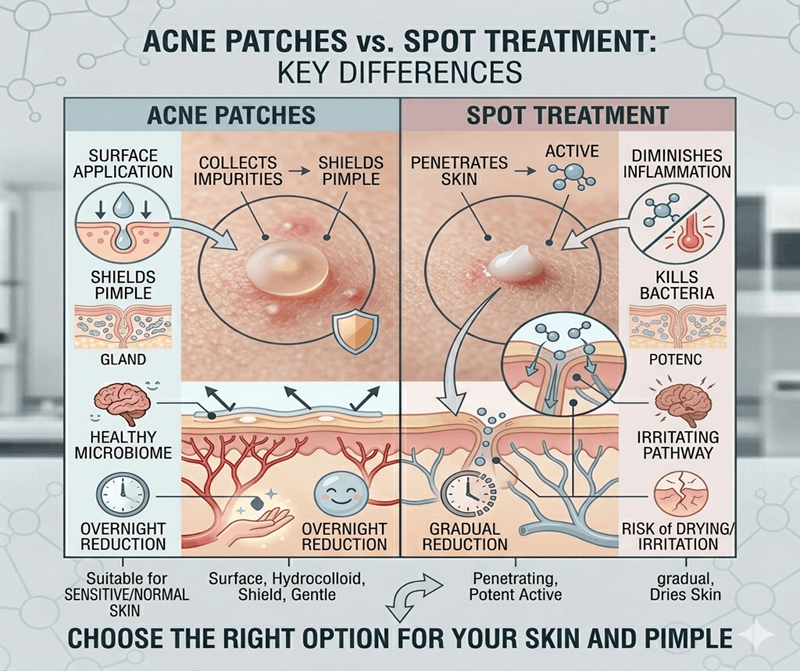
The main distinction which exists between acne patches and spot treatment depends on their methods to tackle the problem. Acne patches function by their surface application, which collects impurities while shielding the pimple, but spot treatment penetrates the skin to diminish inflammation and kill bacteria.
Speed of Results
The presence of a whitehead enables acne patches to provide quicker results. The pimple can be treated with a single application, which you can use during the night to achieve a significant reduction in its size by morning. A spot treatment takes an extended period to produce results because it follows a gradual process.
Skin Type Suitability
Acne patches provide gentle treatment that most individuals can use because they work well with both normal and sensitive skin types. Spot treatment products become dangerous because they dry out the skin and create irritation for users who use products with powerful active components. The acne patches provide a better choice for people who develop skin irritation because they contain fewer irritating ingredients.
When to Use Acne Patches for Best Results
The optimal timing for applying acne patches exists to achieve maximum effectiveness. The better treatment for existing pimples requires acne patches as the preferred solution. The treatment provides efficient results for whiteheads and pus-filled pimples, which require immediate medical attention. The primary benefit of acne patches results from their simple application process. The user needs to cover the pimple area with a patch and leave it on the skin. People tend to use the products during the night because their skin undergoes natural healing processes at that time. The products prevent skin picking, which commonly occurs when people attempt to treat their acne, resulting in permanent skin damage. Acne patches create a barrier that prevents people from touching their pimples, thus enabling proper healing.
When Spot Treatment Works Better
A spot treatment is a better option when the pimple is still forming beneath the skin. If you feel tenderness or a bump that hasn’t surfaced yet, applying a spot treatment can help stop it from developing further. Spot treatment is also more effective for deeper acne, such as cystic breakouts. These types of pimples don’t respond well to patches because there is no surface-level fluid to absorb.
In addition, a spot treatment can be used as part of a long-term acne routine, helping to control breakouts over time rather than just reacting to them.
Can You Use Acne Patches and Spot Treatment Together?
The question of using acne patches together with spot treatment has a positive answer because their application requires proper scheduling. The application of both treatments needs to be avoided because acne patches require direct skin contact for their proper function. The spot treatment needs to be applied first because it provides better results during the initial development of a pimple. The acne patches should be used after the pimple reaches its visible stage because they will remove impurities while accelerating the healing process. The combination enables you to treat acne multiple times, which enhances your overall treatment effectiveness.
Pros and Cons of Spot Treatment
The advantages and disadvantages of acne patches create a complete evaluation of their effectiveness. The primary benefit of acne patches lies in their basic operational design. The product provides a simple application that creates no mess and works effectively on most skin types. The product helps people avoid picking their skin while it creates a protective barrier against outside sources of skin irritation. The product has certain drawbacks that limit its effectiveness. The product only treats surface pimples because it fails to treat deep and cystic acne.
Which One Should You Choose?
The choice between the two really depends on the type of acne you’re dealing with. Acne patches provide the best solution when you need to treat a visible whitehead quickly. The product delivers fast results and provides simple application and skin-friendly performance.
A spot treatment works better when a pimple is still developing, or the user experiences deep-seated pain. Most people actually require multiple options because they need to select only one. The combination of both methods used at appropriate times will deliver superior results compared to using a single method.
Conclusion
The treatment of breakouts requires different methods because no single method can solve every situation. The acne patches and spot treatment comparison process demonstrates the value of understanding their distinct treatment functions because this knowledge enables better skin management.
Acne patches provide an effective solution for visible pimples that require immediate treatment because they offer users an easily accessible method for handling their condition. The product protects the affected area while decreasing pimple tendency and supporting pimple healing through its protective effects. The product allows users to control their breakouts through early skin application, which helps them stop the outbreak from becoming worse.
People need to change their thinking from which choice is better to which choice fits their current requirements. Skincare becomes a lot less frustrating when you match the solution to the situation instead of expecting one product to do everything.
The most effective approach for most individuals involves using both methods throughout different phases of their breakout process. The approach provides users with balanced solutions that enable them to improve skin health while maintaining natural skin function.
People achieve clearer skin through intelligent product selection because product quantity does not determine skin clarity. Your understanding of acne patches and spot treatment usage will bring you closer to achieving your goal.
FAQs
1. Are Acne patches better than spot treatment?
It depends on the type of acne—Acne patches work best for surface pimples, while spot treatment targets deeper acne.
2. Can I use Acne patches and spot treatment together?
Yes, but not at the same time on the same spot. Alternate usage is recommended.
3. How fast do Acne patches work?
They can reduce visible pimples within 6–24 hours.
4. Do spot treatments dry out skin?
Yes, some spot treatments can cause dryness if overused.
5. Are Acne patches safe for sensitive skin?
Yes, they are generally gentle and non-irritating.
6. Which is better for cystic acne?
Spot treatment is usually more effective for deep, cystic acne.