If you have spent any time down a skincare section, you have almost certainly bumped into these two terms. AHA. BHA. They show up on serums, toners, cleansers, and exfoliating pads. Dermatologists recommend them. And yet, if you asked most people to explain the actual difference between the two, you would get a lot of vague answers. Something about acids. Something about exfoliating. Something about not using them together, maybe.
Here is the thing. AHAs and BHAs are not interchangeable. They are not two names for the same category of product. They work through completely different mechanisms, they penetrate to different depths, they suit different skin types, and they solve different problems. This guide breaks down everything you actually need to know, without the filler, without the fluff, and without assuming you have a biochemistry degree.
Let’s Start With Why You Even Need a Chemical Exfoliant
Your skin sheds dead cells naturally. It does this continuously, in a process called desquamation, and when it works the way it should, you never notice it happening. Fresh cells move up from the deeper layers, old cells detach from the surface, and your skin stays smooth, clear, and even-toned.
The problem is that this process does not always work the way it should.
As you get older, cell turnover slows down. Dead cells start to linger on the surface longer than they should, creating the dull, rough, uneven-looking skin that people often mistake for dehydration. In acne-prone skin, the process breaks down differently. Dead cells inside the pore do not shed properly. They mix with excess sebum, accumulate, and create the blockages that eventually become blackheads, whiteheads, and inflamed pimples.
AHAs: The Surface Refiners
AHA stands for alpha hydroxy acid. The most commonly used AHAs in skincare are glycolic acid, lactic acid, mandelic acid, and malic acid. Of these, glycolic and lactic are the most researched and the most widely formulated into consumer products.
The defining characteristic of AHAs is that they are water-soluble. This means their action is concentrated at the skin’s surface. They cannot penetrate through oil, which limits their reach to the outermost layers of the stratum corneum. Within those layers, they are remarkably effective. They loosen the bonds between dead skin cells, accelerate their shedding, and reveal the fresher, brighter cells sitting just beneath.
Beyond exfoliation, AHAs do something BHAs cannot. They stimulate fibroblast activity in the dermis, which triggers new collagen production. Over months of consistent use, this translates to measurably firmer, plumper skin with reduced fine lines and improved overall resilience. Glycolic acid in particular has one of the strongest evidence bases for this collagen-stimulating effect of any over-the-counter ingredient available.
Different AHAs suit different needs and sensitivities. Glycolic acid has the smallest molecular size of the group, which means it penetrates most deeply and delivers the most intensive results. It is also the most likely to cause irritation in sensitive or reactive skin. Lactic acid works more gently and is also a humectant, meaning it attracts and retains moisture while it exfoliates, making it the better starting point for dry or first-time acid users. Mandelic acid is the gentlest of all and is particularly recommended for darker skin tones that carry a higher risk of post-inflammatory hyperpigmentation from more aggressive exfoliation.
BHAs: The Pore Cleansers
BHA stands for beta hydroxy acid. In the context of skincare, BHA almost always refers to one specific ingredient: salicylic acid. This is not a limitation. Salicylic acid is one of the most well-studied, widely validated, and clinically respected actives in the entire field of dermatology.
What makes salicylic acid fundamentally different from every AHA is a single property: it is oil-soluble.
This is not a minor technical distinction. It changes everything about how the ingredient works and who it works for. Because salicylic acid can dissolve through the sebum that fills the follicle, it can penetrate deep inside the pore rather than staying on the surface. Once inside, it performs the same bond-dissolving exfoliation that AHAs do on the surface, but it does it within the follicle lining itself.
Using a salicylic acid face wash for acne is one of the most impactful decisions an oily or breakout-prone skin type can make. Unlike a cleanser that simply removes surface oil and debris, a salicylic acid face wash for acne works inside the pore at every single cleanse, preventing the buildup that eventually becomes a breakout before it ever gets that far. You are not treating problems as they appear. You are stopping them from forming in the first place.
Salicylic acid also carries significant anti-inflammatory properties that AHAs lack entirely. It suppresses the production of prostaglandins, inflammatory signaling molecules that drive the redness, swelling, and tenderness of an active breakout. That dual action on both the structural blockage and the inflammation is why it has remained the cornerstone ingredient of acne treatment for decades.
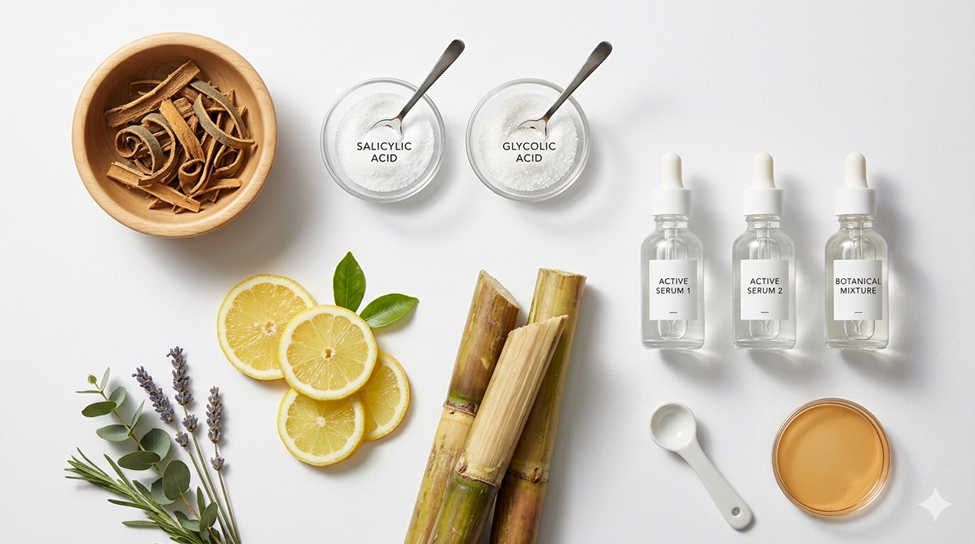
The Real Differences, Side by Side
The water-soluble versus oil-soluble distinction is the most important difference, but it helps to see the full picture clearly.
AHAs work on the skin surface. They target dead cell buildup in the outer layers, stimulate collagen synthesis, brighten skin tone, fade hyperpigmentation, and improve surface texture and radiance. They are most effective for dry, mature, sun-damaged, or dull skin.
BHAs work inside the pore. They dissolve sebum plugs and follicular congestion, normalize cell turnover in the follicle lining, reduce both the structural and inflammatory components of acne, and minimize pore appearance over time. They are most effective for oily, combination, acne-prone, or blackhead-heavy skin.
Both increase photosensitivity and require daily SPF. Both work best with consistent use over weeks and months. Both deliver significantly better results when the skin barrier is being actively maintained and supported alongside them.
How to Build This Into a Real Routine
A morning routine for oily, acne-prone skin is straightforward. Cleanse with a salicylic acid face wash for acne, apply a niacinamide serum for oily skin and allow it to absorb fully, follow with a lightweight non-comedogenic moisturizer, and finish with SPF. Four steps. Five minutes. Every morning.
An evening routine adds the targeted treatment layer. Cleanse again with your salicylic acid face wash for acne, apply your niacinamide serum for oily skin, and on exfoliation evenings add a leave-on BHA toner or serum between the cleanser and the niacinamide. On AHA evenings, apply the acid after cleansing, let it absorb, then layer the niacinamide serum on top before moisturizing.
For active breakouts that appear between exfoliation sessions, a fast-acting acne spot corrector applied directly to the pimple shortens its lifespan without disrupting the rest of your routine. For surfacing pimples at night, a pimple patch draws out the fluid while you sleep and eliminates the picking that causes most long-term acne scarring.
A barrier repair moisturizer used consistently through all of this keeps the skin resilient enough to sustain everything you are asking of it. Ceramides in the formula replenish the barrier lipids that acid exfoliation temporarily depletes, maintaining the skin integrity that makes every other product in your routine work more effectively.
The Myths Worth Clearing Up
Tingling means it is working. This is false. Mild, brief tingling on first application sits within the normal range for some people. Burning or significant stinging that persists is a signal that the concentration is too high or the barrier is too compromised for that product right now.
Stronger is always better. Also false. A well-formulated daily product at 5% to 10% AHA or 1% to 2% BHA used consistently over months produces excellent, sustainable results. The goal is the most effective treatment your skin can sustain indefinitely, not the most aggressive one it can barely tolerate.
You cannot use AHA and BHA together at all. This is an oversimplification. Layering them in the same application at high concentrations daily is inadvisable. Alternating them on different evenings is a well-established, effective practice used by dermatologists and seasoned skincare enthusiasts alike.
The Bottom Line
AHAs refine the surface. BHAs clear the pore. Niacinamide regulates what fills it. Together, these three ingredients address the full cycle of oily, acne-prone skin more comprehensively than any single product ever could. Start with the right ingredients for your primary concern. A salicylic acid face wash for acne and a niacinamide serum for oily skin are your foundation if breakouts and excess oil are the main story. An AHA is your primary tool if surface texture and hyperpigmentation are what you are dealing with. Use them consistently, protect your work with daily SPF, support your barrier with ceramides, and give the process the weeks it genuinely needs to show you what properly chosen skincare can do.
The results are not instant. But when you get the fundamentals right, they are lasting in a way that no shortcut ever delivers.
FAQs
Q1. What is the difference between AHA and BHA in skincare?
AHAs are water-soluble acids that exfoliate the skin surface while BHAs are oil-soluble acids that penetrate deep inside the pore to clear congestion and fight acne from within.
Q2. Can I use AHA and BHA together in the same skincare routine?
Yes, but alternate them on different evenings rather than layering both in the same application to avoid irritation and barrier disruption.
Q3. Can California Skin+ Acne Control Cleanser be used daily?
Yes, the California Skin+ Acne Control Cleanser is formulated for twice daily use and works as the foundation of any acne clearing routine without over-stripping the skin.
Q4. How often should I use a chemical exfoliant?
Start two to three times per week and gradually increase to daily use only after your skin has fully adjusted without any signs of irritation or sensitivity.
Q5. Which is better for acne, AHA or BHA?
BHA, specifically salicylic acid, is better for acne because its oil-soluble nature allows it to penetrate inside the pore and break down the blockages that cause breakouts.
Q6. Is the California Skin+ Acne Control Serum suitable for sensitive oily skin?
Yes, the California Skin+ Acne Control Serum is formulated with niacinamide and skin-balancing actives that regulate oil and clear breakouts while maintaining barrier integrity even on sensitive oily skin types.