You can have the most impressive ingredient list on your cleanser. Salicylic acid, niacinamide, ceramides, hyaluronic acid. All the right things. And your routine can still underperform not because the ingredients are wrong but because the pH of the product is wrong. pH is the factor that determines whether every active ingredient in your skincare actually works as intended, and it is also the factor that most people have never thought about for even one second.
Understanding pH is not about becoming a chemistry expert. It is about understanding one simple principle that explains why some cleansers cause rebound oiliness, why some leave your skin feeling tight and irritated no matter how gentle they seem, and why switching to a properly formulated pH balanced face wash can transform your skin in ways that ingredient swaps alone cannot.
What Is pH and Why Does Your Skin Have One?
pH is a measurement of how acidic or alkaline a substance is, measured on a scale from 0 to 14. A pH of 7 is neutral (pure water). Below 7 is acidic. Above 7 is alkaline. Your skin has a naturally acidic pH of approximately 4.5 to 5.5, maintained by what is called the acid mantle, a protective film on the skin surface made up of sebum, sweat, and naturally occurring acids.
This acid mantle is not a marketing concept. It is a real and critical component of your skin’s defence system. It protects against environmental pathogens by creating an environment that is inhospitable to harmful bacteria and fungi. It supports the function of the enzymes responsible for skin cell shedding. It maintains the integrity of the skin barrier. And it keeps the microbiome that lives on your skin in a healthy balance.
When the pH of your skin is disrupted, every one of these functions is compromised simultaneously. The consequences are visible: increased breakouts, dryness, sensitivity, and a skin barrier that struggles to perform its basic protective functions.
What Happens When You Use the Wrong pH Cleanser?
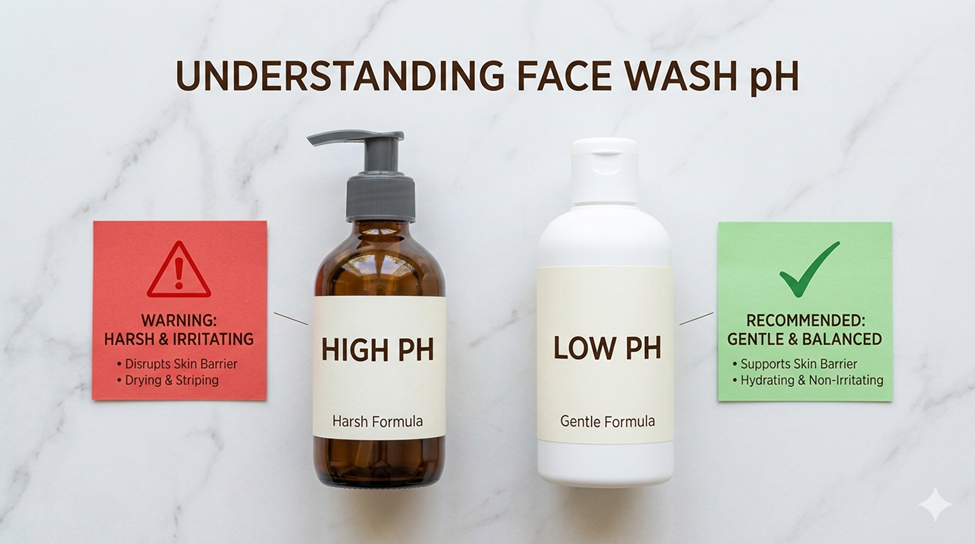
Most traditional bar soaps have a pH of 9 to 10. Many popular foaming face washes sit between 7 and 8. Your skin’s optimal pH is 4.5 to 5.5. Every time you wash your face with a high pH product, you are temporarily alkalizing your skin surface significantly. And while your skin does work to restore its natural pH over time (a process that takes anywhere from 30 minutes to several hours), repeated daily disruption prevents it from ever fully recovering.
The consequences of chronic high pH cleansing are predictable and well documented. The alkaline environment encourages the growth of acne causing bacteria, which thrive at higher pH levels. The enzymes responsible for the natural shedding of dead skin cells are disrupted, leading to cellular buildup that clogs pores. Ceramide production in the skin is impaired, weakening the barrier. Transepidermal water loss increases, causing the dehydration and tightness that many people experience as a post cleanse sensation.
The rebound oiliness that many people experience after cleansing with a harsh face wash is a direct consequence of this pH disruption. The skin interprets the sudden shift in surface chemistry as a barrier emergency and produces more sebum to compensate, making you oilier than before you washed.
Why pH Affects How Active Ingredients Work
This is where pH becomes directly relevant to every active ingredient in your skincare routine, not just your cleanser. Many of the most important skincare actives are pH dependent, meaning they only work correctly within a specific pH range.
Salicylic acid (BHA) is most effective at a pH of 3 to 4. If your cleanser raises your skin’s pH significantly before you apply your salicylic acid serum, the serum is working against a skin surface that is no longer at the optimal pH for its activity. The same applies to vitamin C, which requires a pH below 3.5 for maximum stability and efficacy, and to AHAs, which work most effectively between pH 3 and 4.
A well formulated cleanser that respects your skin’s natural pH creates the optimal foundation for every product you apply afterward. One that disrupts your pH creates a hostile environment for everything that follows, regardless of how good those products are individually.
The Optimal pH for a Cleanser
A cleanser formulated for acne prone skin should ideally have a pH between 4.5 and 5.5, matching your skin’s natural acid mantle. Some cleansers with salicylic acid work at a slightly lower pH of 3.5 to 4.5 to keep the salicylic acid active during the time it is in contact with the skin before rinsing.
Very few brands publish their exact pH on packaging, which makes this information difficult to access without testing. pH testing strips (litmus strips) are inexpensive and available widely online. Adding a small amount of cleanser to water and testing it with a pH strip gives you a reliable indication of where a product sits. Any cleanser testing above pH 6 on acne prone skin is worth reconsidering.
How to Tell if Your Cleanser Is the Wrong pH
Your skin will tell you if your cleanser is disrupting its pH, if you know what to look for. The most common signs of a high pH cleanser are skin that feels tight, dry, or uncomfortable immediately after cleansing and rinsing. Skin that becomes oily and shiny within an hour or two of washing. Increased sensitivity to other products applied after cleansing. A persistent feeling of irritation or mild stinging when applying serums or toners. And breakouts that continue despite consistent product use and a diet that should not be causing them.
If you recognize several of these signs, your cleanser is almost certainly disrupting your acid mantle chronically. The fix is not to add more products. It is to switch to a pH appropriate cleanser and give your skin two weeks to restore its natural balance.
What to Look for in a pH Balanced Cleanser
Beyond pH, several other formulation characteristics indicate a cleanser that will support rather than disrupt your skin. Gentle surfactants are the cleansing agents responsible for removing oil and debris. Mild options like cocamidopropyl betaine, sodium cocoyl glycinate, and decyl glucoside clean effectively without the aggressive barrier stripping of sodium lauryl sulfate.
The absence of fragrance is the next most important criterion for acne prone skin. Fragrance is the leading cause of contact dermatitis and skin sensitization in skincare products, and a sensitized skin barrier is one that cannot maintain its natural pH effectively. Fragrance free should be a non negotiable for any cleanser you are using daily on acne prone skin.
pH and Your Complete Routine
Once you have a pH appropriate cleanser in place, your entire routine becomes more effective because every subsequent product is working on a skin surface that is at its optimal pH. Your salicylic acid serum penetrates more effectively. Your niacinamide delivers better sebum regulation. Your active treatments have access to a skin environment where they can function as intended rather than working against an alkaline surface.
A moisturizer for acne prone skin applied after a pH balanced cleanse absorbs more effectively because the barrier it is landing on is intact rather than compromised. The difference between a routine built on a pH disrupting cleanser and one built on a pH appropriate one is often the difference between a routine that works and one that does not, regardless of everything else in it.
The Myth of Squeaky Clean
The squeaky clean feeling that many people associate with a good cleanse is one of the most persistent and damaging myths in skincare. That sensation is caused by protein precipitation on the skin surface from exposure to alkaline cleansers. It is the tactile equivalent of what happens when you soak hair in high pH water and it becomes rough and tangled. It is not a sign of thorough cleansing. It is a sign of barrier disruption.
Properly cleansed skin at the correct pH feels comfortable, balanced, and soft after washing. Not tight. Not stripped. Not immediately greasy (because the rebound sebum response has not been triggered). Just comfortable. If that sensation is unfamiliar to you from your current cleanser, it is worth experiencing what your skin can feel like with the right formula.
The Bottom Line
pH is the most underrated factor in skincare formulation and the one with the most direct impact on whether everything else in your routine works as it should. A pH appropriate cleanser does not just clean your face. It preserves the acid mantle that protects your skin, maintains the environment that your active ingredients need to function, and sets up every product that follows it for success. Getting your cleanser right is not just step one of your routine. It is the foundation that determines whether steps two through ten have any chance of delivering results.
FREQUENTLY ASKED QUESTIONS
Q: What is the ideal pH for a face wash?
A: The ideal pH for a face wash for acne prone skin is between 4.5 and 5.5, matching the skin’s natural acid mantle.
Q: How do I know if my cleanser is the wrong pH?
A: Signs of a high pH cleanser include skin that feels tight or uncomfortable after washing, rebound oiliness within an hour of cleansing, increased sensitivity to other products, and persistent breakouts despite a consistent routine.
Q: Is bar soap bad for acne prone skin?
A: Traditional bar soap typically has a pH of 9 to 10, which is significantly more alkaline than the skin’s natural pH of 4.5 to 5.5.
Q: Why does my skin get oilier after washing?
A: Rebound oiliness after cleansing is almost always caused by a cleanser that is too alkaline or too stripping.
Q: Which California Skin+ product is best for maintaining skin pH?
A: The California Skin+ Acne Control Cleanser is formulated at an optimal pH for acne prone skin with gentle surfactants and salicylic acid.
Q: Can the California Skin+ Acne Control Serum work better with a pH balanced cleanser?
A: Yes absolutely. The California Skin+ Acne Control Serum contains niacinamide and salicylic acid, both of which work most effectively on skin that has been cleansed to the correct pH.