There are moments. A moment that occurs almost instinctively. The face gets washed, the towel drops down, and a searching occurs before. Before, before. Before the mind has a chance to comprehend what has occurred. It is never a full scan. It goes straight to the usual spots. The chin. The jaw. The cheek that always acts up first. The reaction is instant. Sometimes it is frustration. It has sometimes been a sign of defeat. A deep breath before a day begins. Such a scene is seldom discussed. It is familiar.
Acne does not always hurt loudly. It does not always come with pain or swelling. Sometimes it wears people down slowly. It becomes background noise in daily life. The thing that quietly affects confidence, clothing and lighting preferences, and mood. It almost becomes routine in a way that makes it unfair.
There is effort behind it. More than most people realize. Bottles are bought with hope. Routines are adjusted again and again. Advice is followed carefully, sometimes obsessively. Ingredients are researched. Timelines are tracked. Progress is monitored in mirrors and phone cameras. And yet the skin still looks irritated. Or tight. Or shiny in such a way that it does not feel healthy. The kind of shine that feels awkward rather than radiant.
That’s what makes the experience confusing because everything that should make the situation improve makes it worse.
Why Tight Skin Is Not a Sign of Clean Skin
For years, clean skin was defined by a feeling. Tight. Almost stiff. That squeaky sensation after washing was treated like proof that something worked. The oil was gone. The pores were empty. The face was clean. That idea runs deep. It shows up in advertisements, in advice from well-meaning people, and in bathroom routines passed down over time. But healthy skin has absolutely no need to announce itself in that way. It doesn’t pull, sting, feel uncomfortable. It just is quietly there and doesn’t act up after cleansing.
If your skin feels tight after washing, that does not necessarily mean your skin has been made freshly clean. It likely means that your skin has not been provided with an essential ingredient a gentle cleanser with a component of Salicylic Acid that not only cleans pores but does not wash away appropriate moisture.
Acne rarely comes from not cleaning enough. It more often comes from skin that has been pushed past what it can comfortably handle for too long. Skin is not passive. It is not something that simply tolerates whatever is placed on it. It responds constantly. To water. To temperature. To ingredients. To friction. To how often it is touched or how aggressively it is treated.
What Science says About Your Skin Barrier
According to a study that appeared in a Journal of Clinical and Aesthetic Dermatology, is that your external skin layer, known as your skin barrier, functions as a wall that locks in moisture and locks out irritants. When you wash your skin too harshly, this wall gets damaged, causing your skin to lose moisture at a worse rate, as well as creating inflammation that often leads to more serious cases of acne. Moreover, this also allows acne-causing agents a better environment in which to multiply, as your damaged walls will do nothing to stop them.(Source)
The Skin Barrier Most People Don’t Realize They’re Damaging
Perhaps one of the vital things that skin needs is a skin surface barrier. This barrier is thin and invisible; nevertheless, this barrier is quite busy in its work. It maintains moisture retention. It prevents irritants from coming in. It controls oil production. It helps in the natural healing of the skin in the background without any fuss or interference.
Since that obstacle is present, dramatic feelings are not felt when touching the skins. The oil content remains decent. The texture is not too rough. Even with those occurrences of zits, they heal more quickly without leading to days and days of inflammation.
If this barrier is disrupted, the skin changes rapidly. Many cleansers disrupt it without making the damage obvious at first. Especially the ones that foam heavily or promise deep cleaning. They feel strong. They smell fresh. They provide immediate feedback that is rewarding.
What they really end up doing is removing it at a rate that is more rapid than it is replaced. Once that protection is gone, it’s easy for that moisture to leave and go up in the air. The surface has a tight feel to it some of the time. Some of it has an itchy feel to it other times. Other times it feels strangely shiny and as though it’s simultaneously dry. The skin feels all of this and responds in the only way it currently understands how.
Common Cleansing Patterns and How Skin Usually Responds
| What happens after washing | What the skin is likely reacting to | What often shows up over time |
| Skin feels tight within minutes | Protective oils stripped too quickly | Increased oil production and recurring breakouts |
| Face stings or burns slightly | Fragrance, alcohol, or barrier disruption | Ongoing sensitivity and redness |
| Skin looks shiny by midday | Skin is trying to replace lost moisture | Adult acne and enlarged-looking pores |
| Tiny bumps appear under the skin | Residue or pore clogging ingredients | Persistent congestion and uneven texture |
| Dry patches mixed with oil | Barrier struggling to regulate itself | Flaking, irritation, and slow healing |
| Breakouts appear in new areas | Irritation rather than true purging | Acne that worsens instead of settling |
Why Over-Cleansing Often Leads to More Acne
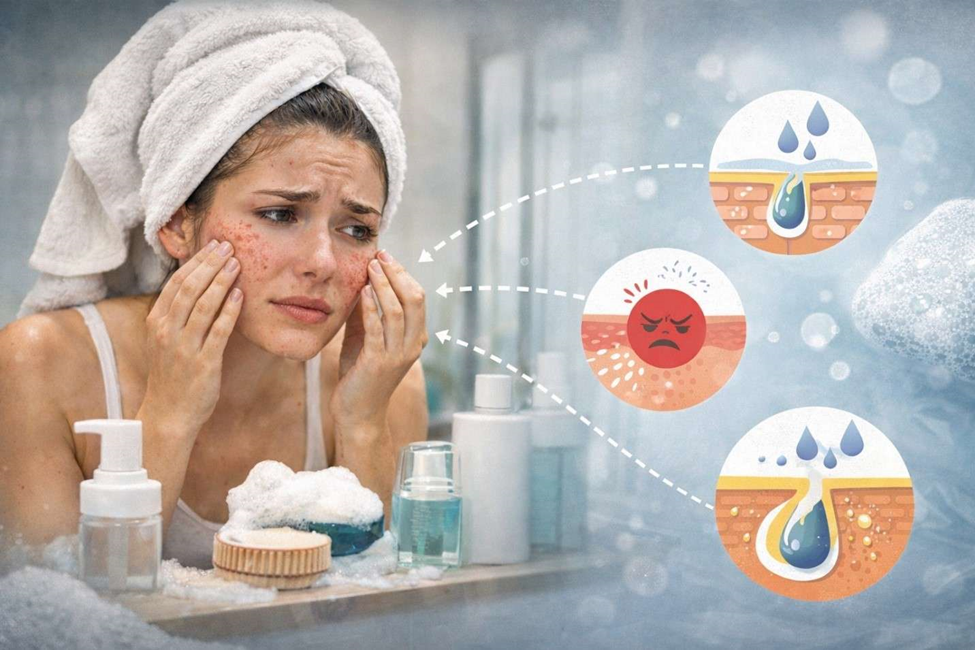
It produces oil. Not because it wants to clog pores. Not because something is wrong. Oil is protective. Oil is how skin tries to defend itself when its natural shield has been compromised.
This is where frustration usually builds. Oil appears, so harsher cleansing feels necessary. Extra washing feels logical. Stronger products feel responsible and proactive. But every aggressive step sends the same message to the skin. The problem is still here. The environment is still unsafe.
Trapped oil collects under stressed skin layers. Dead skin cells stop falling off skin normally. Instead of shedding normally, skin cells bond to the skin. Pores begin to clog, silently and without warning. It accumulates deeper under the surface. Breakouts appear further under the surface. Redder. More resistant. More difficult to soothe.
Nothing about this means the skin is failing. So that means that the skin has responded just the way that it is supposed to respond. While the squeaky-clean sensation tended to be well praised, it is one of the clearest indicators. It meant that there was simply too much being removed in one step.
Many foaming cleansers rely on ingredients that clean without nuance. They remove everything in their path. Excess oil and necessary oil. Temporary buildup and long-term protection. Facial skin does not need force. It needs balance. If there is any change in the normal pH level of human skin, bacteria that cause acne will begin to breed quickly. On another note, there will be challenges facing the skin in disposing of dead cells. Instead of falling away gradually, those cells stick together and settle into pores.
Inflammation follows. Congestion follows. Acne follows. This is why harder cleansing rarely leads to clearer skin, even though it feels productive in the moment. Not all reactions will be dramatic or readily evident. At other times, it will be too subtle to be explained or dismissed. Texture changes slowly. Skin feels rougher in certain areas. Tiny bumps appear that do not fully turn into pimples. Makeup stops sitting the way it used to. The face looks dull, even though oil appears quickly.
These signs point to congestion.
Congestion often comes from residue left behind. Cleansers attempt to make hard-cleansing activities softer by increasing the weight of the cleansers. The smooth feeling of the skin is comforting. However, not all of these washing agents remove residue completely.
They stay behind. Inside pores. Quietly building over time.
This is how acne can feel confusing and unfair. The cause is not always obvious. Sometimes it hides inside products that feel helpful at first.
Skin communicates constantly. It gives feedback every single day.
- Tightness after washing means moisture was stripped.
- Burning or stinging signals irritation.
- Rapid oiliness suggests compensation.
- Small uniform bumps hint at clogged pores.
- Flaking paired with shine points to barrier stress.
These signs are easy to ignore early on. Over time, they get harder to overlook.
Purging vs Irritation: Knowing the Difference
One of the most misunderstood ideas in acne care is purging. The belief that skin must get worse before it gets better. Purging does exist, but it is specific. It happens when strong active treatments increase cell turnover and push existing congestion to the surface. A basic cleanser does not cause purging.
Breakouts that appear in unusual places after starting a new face wash are not part of a healing phase. They are feedback. Especially if it is with itching, burning, or tenderness. True purging follows patterns and settles. Irritation escalates. Skin should not feel progressively worse week after week from something as basic as cleansing.
Conclusion
When stress is removed, skin begins to regulate itself again. Not instantly. Not perfectly. But gradually and noticeably. The easier your daily procedures are, the better they are. Gentle cleansing. Lukewarm water. No scrubbing. No harsh instruments.
Hot water makes you feel cozy but can strip an already compromised skin barrier of important oil filters in an instant. Scrubs can be incredibly productive, but they can also slow down a skin barrier in trouble to begin with.
Fingertips are enough. Light pressure is enough. Short contact time is enough. Skin renewal takes time. Around a month for a full cycle. Calm usually returns before visible clarity does. While a face is erupting, treatments can target a breakout and stop it without treating the rest of the face. Not control, not perfection. Stability.
Acne is not a lack of discipline. It is not laziness. It is not failure. It is communication. And once that communication is understood, skincare becomes quieter. Less reactive. Less exhausting. The mirror stops feeling like a daily test and starts feeling neutral again.
Your Questions, Answered
If I wash my face quickly can it still trigger acne?
Yes. Barrier disruption and pore clogging can happen within seconds.
Why does skin Itch After Washing?
Itching is really annoying. It usually happens because of irritation. This irritation is often caused by fragrance, preservatives or dry skin. These things can stimulate the nerve endings. That is what makes us feel itchy.
Is stopping face washing entirely a good option?
No. Sweat, sunscreen, pollution, and everything the skin has accumulated still need to come off. All that needs to change in the cleaner is how soft it is.
Is natural soap always better for acne?
Not necessarily.it totally depends upon the soap’s pH level.
How can barrier damage be recognized?
Skin that feels tight but looks shiny or products that suddenly sting are common signs.