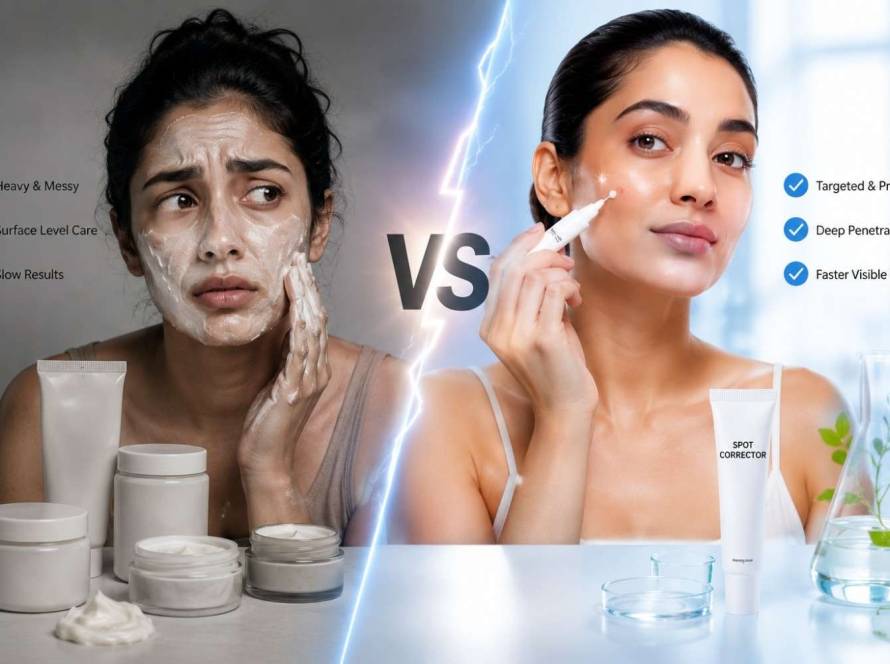
There’s a very specific kind of guilt that comes from standing in a skin care aisle, picking up a moisturizer, and then noticing the one sitting right next to it labeled “night version” , same brand, similar packaging, slightly different promises, and a price tag that makes the whole thing feel like a commitment. The unspoken message is hard to miss. You’re supposed to buy both. Using just one is apparently the beginner move, the thing people do before they really understand skin care products.
That narrative has been running for decades now, and it has done an extraordinary job of making people feel like their routines are incomplete. But the actual question , do most people genuinely need two separate moisturizers , has a much more practical answer than the beauty industry tends to let on.
The global moisturizer market crossed 18 billion dollars in 2023 according to the NPD Group, with specialized formulas like night creams pulling significant growth. There’s real financial infrastructure built around keeping the two-product idea alive. That doesn’t automatically make it wrong, but it does mean the advice to buy both isn’t coming from a neutral place, and it’s worth understanding the actual science before deciding what your skin genuinely needs versus what somebody’s quarterly revenue targets need.
Skin During the Day Is Essentially Playing Defense

The reason day-versus-night even becomes a conversation worth having at all is that the skin really does behave differently at different times, and those behavioral differences have real implications. This isn’t invented to sell products. The biology is legitimate. It’s the conclusions drawn from that biology that sometimes get stretched further than the evidence actually supports.
During the day, the skin is in constant contact with everything the outside world throws at it. UV radiation is the most obvious stressor, but it’s not the only one. Pollution particles settle on the skin surface and generate oxidative stress. Blue light from screens has been shown to affect skin in ways researchers are still mapping. Temperature changes between outdoor heat and air-conditioned indoor spaces stress the barrier repeatedly throughout the day. Wind strips surface moisture. The skin’s barrier is working against all of this simultaneously, and that work costs something.
Transepidermal water loss , which is just a technical way of saying moisture evaporating off the skin surface, increases during environmental exposure. Skin that started the morning well-moisturized can be running a meaningful hydration deficit by mid-afternoon without ever feeling dramatically dry, because the loss is gradual and the skin compensates as best it can.
A morning barrier repair moisturizer is doing a specific job in this context. Lightweight enough to layer under sunscreen without turning into a pilled, greasy mess by 10am. Rich enough in antioxidants that it can neutralize some of the free radical damage from UV and pollution in real time, which nothing applied hours later at night can undo retroactively. Stable enough in formula that it holds up across a full day of environmental stress rather than wearing off by lunchtime.
What Skin Gets Up To While the Rest of the Body Sleeps
Most people assume nighttime is recovery time across the board, body resting, skin resting, everything slowing down and waiting for morning. The resting part of the body is accurate. The skin resting part is almost completely wrong.
While the body sleeps, the skin shifts into an entirely different operational mode. Cortisol levels fall, which reduces the systemic inflammation that accumulates during the day. Cell turnover , the process by which old skin cells are shed and new ones surface , accelerates dramatically during sleep, with some research suggesting nighttime regeneration runs two to three times faster than during waking hours. Blood flow to the skin surface increases, bringing more oxygen and nutrients to where the repair work is happening.
And then there’s the detail that genuinely surprises most people when they first hear it: transepidermal water loss actually peaks at night. Not during the day when the skin is being battered by the environment, but during sleep. Research published in the Journal of Investigative Dermatology in 2019 confirmed that skin barrier permeability hits its highest point between 11pm and 4am. The barrier becomes more permeable during those hours, which means water moves through it more freely than at any other time. (Source)
Nobody feels this happening. There’s nothing uncomfortable about it because the person attached to that skin is unconscious. But the skin is losing more moisture during those hours than most people account for, and it’s doing so during the exact window when repair processes are most active. A well-chosen barrier repair moisturizer applied before sleep isn’t just sitting there doing nothing. It’s offsetting that overnight moisture loss while the skin’s own regeneration cycle runs. Natural skin care products with the right ingredients can genuinely amplify what the skin is already trying to accomplish during those hours, which is a meaningful thing to support rather than leave unaddressed.
Whether Two Products Are Actually Necessary
Laid out plainly, without the marketing layer on top: for most people, one well-formulated barrier repair moisturizer used consistently twice a day covers what two separate products are each trying to accomplish individually.
The specialty product world has put a lot of work into making “specialized” feel like the more serious, more effective category. But the benefits that matter most for skin health , ceramides that replenish the structural lipids of the barrier, long-acting hydrators that improve the skin’s own ability to retain moisture, anti-inflammatory botanicals that calm reactivity and support healing, none of these have a time preference. They’re not delivering daytime benefits during the day and nighttime benefits at night. They’re addressing the barrier continuously, and a barrier repair moisturizer that contains them well is doing meaningful work every time it’s applied regardless of the clock.
The Barrier Is Where the Actual Conversation Lives

The day-versus-night framing gets most of the attention, but it’s somewhat missing the point. The more foundational question , the one that actually determines how every moisturizer performs regardless of when it’s applied , is the health of the skin barrier itself.
A compromised barrier doesn’t care what time it is. It loses moisture around the clock. It lets irritants in during the day and fails to repair as efficiently at night. It makes every skin care product less effective because the foundation everything else depends on is unstable. And no combination of two average moisturizers applied at separate times of day addresses a barrier that’s genuinely struggling. What addresses it is consistent, targeted support from a barrier repair moisturizer with ingredients that actually work on barrier structure specifically.
Ceramides are the structural lipids that hold the skin’s barrier together at a cellular level. When they’re depleted by harsh cleansers, acne treatments, weather, or just sustained stress over time, the barrier becomes porous and reactive in ways that affect everything from moisture retention to breakout frequency to how the skin tolerates other products. Replenishing them is foundational work, and it needs to happen regularly regardless of whether it’s morning or evening when the barrier repair moisturizer goes on.
What’s Actually in the Formula Matters More Than What Time It’s Applied
A practical way to cut through the noise around specialized day and night products is to focus on ingredient function rather than product category. Because the time of day that’s most relevant for a given ingredient has nothing to do with what the label says.
Antioxidants , green tea extract, ginseng, vitamin C , do their best work in the morning because that’s when the skin is actively facing the oxidative stress they’re designed to neutralize. They’re not harmful in a nighttime formula, but their core value is defensive and that defense is needed during hours of actual exposure.
Peptides, particularly nonapeptides that signal the skin to support collagen production and structural repair, are well-suited to evening application because they work in sync with the nighttime regeneration cycle. The skin is already running accelerated repair during those hours, and peptides support and extend that process in ways that compound visibly over weeks of consistent use.
Long-acting hydrators like Pentavitin are relevant at both times of day without qualification. Clinically shown to bond directly to keratin proteins in the skin and maintain hydration for up to 72 hours, this ingredient is addressing the skin’s moisture-retention capacity itself rather than just adding a temporary surface layer. It holds through daytime environmental stress and through the overnight permeability window simultaneously. This is exactly the argument for one very good barrier repair moisturizer over two mediocre ones: the right ingredients do meaningful work around the clock rather than just covering one part of the day.
Cica extract, olive squalane, marine algae , barrier support and inflammation control are not time-specific needs. Reactive, inflamed skin doesn’t calm down because it’s morning and flare back up because it’s evening. Ingredients that address these things consistently are more valuable than anything that claims to specialize in just one window.
The Routine That Actually Gets Done Is the One That Works
Skin improves over time through accumulation, and accumulation requires consistency. A 2020 review in the Journal of the European Academy of Dermatology and Venereology found that patients who simplified to fewer, better-chosen products had better long-term outcomes than those using complex multi-step routines, largely because they actually maintained the habit. Complicated routines get abandoned when life gets busy, when someone’s traveling, when motivation dips , and the skin pays the price of that inconsistency regardless of how good the individual products were.
Among the natural skin care products designed from scratch for exactly this kind of reliable, twice-daily role , particularly for skin dealing with acne, barrier damage, sensitivity, or post-treatment dryness , the California Skin+ Barrier Repair Moisturizer was built with this reality in mind. Three essential ceramides handle the structural barrier repair that’s needed regardless of the hour. Pentavitin delivers hydration that holds through a full day of environmental stress and through the overnight moisture-loss window without needing to be supplemented or swapped out. Nonapeptides work with the nighttime cell regeneration cycle in ways that improve texture visibly over consistent use. Olive squalane nourishes without adding congestion to skin that’s already managing oil and breakouts. Cica extract keeps inflammation controlled whether the trigger is afternoon pollution or 3am barrier permeability.
Things Worth Being Clear-Eyed About Before Deciding
A few practical points worth considering before landing on whether to consolidate or keep two products running:
- Sunscreen in the morning is non-negotiable regardless of how strong the moisturizer underneath it is. A barrier repair moisturizer is not an SPF substitute. It goes under sunscreen, every single morning, full stop.
- Anyone on prescription retinoids or strong actives at night should follow their dermatologist’s specific guidance on what to layer around those ingredients. Some prescription routines have formulation requirements that override general principles about moisturizers.
- Skin that feels noticeably tighter or more reactive by evening despite a morning moisturizer may simply need the barrier repair moisturizer applied at night as well, before reaching for an entirely different product to solve the problem.
- Natural skin care products designed for reactive or acne-prone skin tend to reward consistency over novelty. The barrier responds cumulatively to the same dependable ingredients given twice daily. Rotating between products resets that accumulation repeatedly.
Conclusion
When you strip away the marketing, the decision isn’t really about day versus night, it’s about whether your moisturizer is doing enough for your skin every time you use it. Most skin doesn’t need two different formulas competing for attention; it needs one well-formulated barrier repair moisturizer applied consistently, morning and night, that supports hydration, repair, and resilience around the clock. If your skin feels stable during the day and recovers comfortably overnight, you’re already covering both roles effectively. In the end, it’s not the number of products that determines results, it’s how reliably the right one supports your skin over time.
FAQs
Q1. Is there any reason not to use the same barrier repair moisturizer morning and night?
For most skin types, no. Using a barrier repair moisturizer twice daily is generally more effective than once, especially for improving barrier strength. The only thing to check is whether it layers well under sunscreen without pilling or feeling too heavy.
Q2. Can natural skincare products repair the skin barrier overnight?
Yes, overnight is when the skin’s repair processes are most active. Ingredients like ceramides, long-lasting hydrators, and soothing botanicals support this natural repair cycle and help restore the barrier more efficiently.
Q3. Can California Skin+ replace both a day and night moisturizer?
For most people with oily, acne-prone, or reactive skin, yes. It’s designed for twice-daily use, providing barrier repair, hydration, and calming benefits in a single formula that works well both under SPF and overnight.