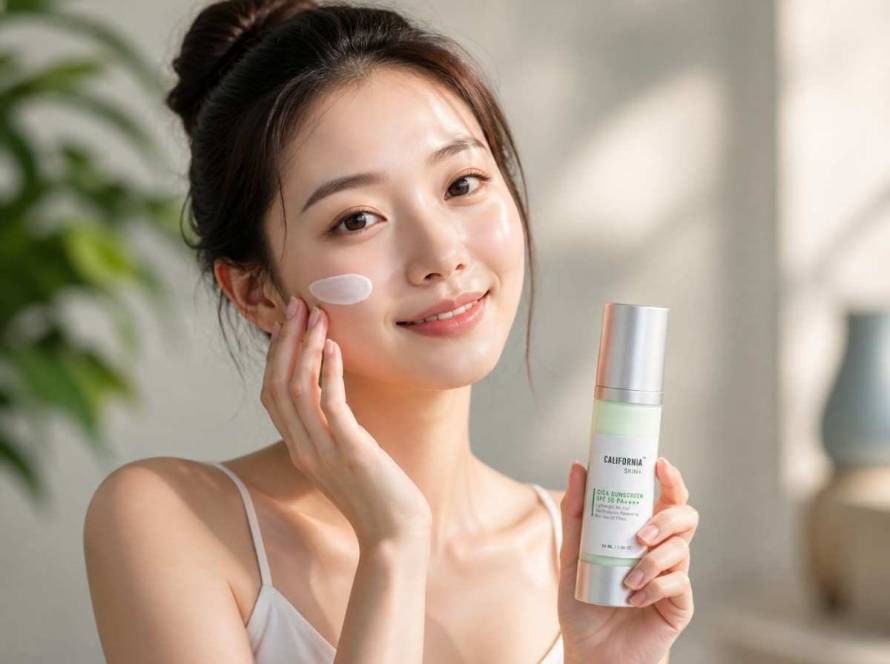
You must apply sunscreen each morning at the beginning of your day. You need to apply SPF 50 as your final step of the day because you must not omit this step. The mirror reflects your skin tone from July which has become darker than your original skin color from April. Your three months of effort to reduce hyperpigmentation have achieved no success because the condition returned to its initial state. You have received an unwanted tan that now covers your shoulders. The SPF 50 bottle on your bathroom shelf appears to be completely harmless.
Nobody tells you this part. The part where SPF 50 is not actually doing what you assumed it was doing when you bought it. Not because the number is wrong but because it is answering a completely different question from the one you thought you were asking.
If the sunscreen in your current routine does not carry both SPF 50 and a PA++++ rating with ingredients that actively work with your skin, a cica sunscreen with broad spectrum protection is worth looking at before reading another word about why your current one is falling short.
SPF 50 Is Only Answering Half the Question
This is the part that genuinely changes how people think about sunscreen once they hear it properly.
SPF measures one specific thing. How much longer it takes for UVB rays to produce a visible sunburn on skin that is wearing sunscreen versus skin that is wearing nothing at all. That is the entire job of the SPF number. It tells you about burning. Nothing else.
Tanning is not caused by the rays that burn you. Tanning, hyperpigmentation, dark spots, uneven skin tone, the kind of slow aging damage that takes years to fully show up on your face but was accumulating the whole time, all of that comes primarily from UVA rays. And the SPF number on the front of your sunscreen says absolutely nothing about UVA protection.
According to the Skin Cancer Foundation, UVA rays account for roughly 95 percent of all UV radiation that reaches the earth’s surface on a daily basis. They come through on overcast days. They come through car windows and office glass. They are present at consistent levels year-round regardless of season or temperature. UVB rays, the ones that cause burning and the ones that SPF actually measures, make up about 5 percent of daily UV exposure.
So when SPF 50 goes on every morning and the skin keeps tanning anyway, it is because the product was doing an excellent job on 5 percent of the problem while the other 95 percent was coming through completely unblocked. That is not a product defect. That is a measurement system that was never designed to tell the whole story.
The Rating That Most Sunscreens Do Not Even Show You
Across skincare markets in Asia, every sunscreen carries two ratings side by side. SPF for UVB protection and PA for UVA protection. The PA system is the part of the label that actually communicates how much protection against tanning and long-term pigmentation damage is present in the formula.
| PA Rating | UVA Protection Level | What It Means |
| PA+ | Minimal | Very low protection; tanning can still happen easily |
| PA++ | Moderate | Basic protection; some defense against tanning |
| PA+++ | High | Good protection; helps reduce tanning and skin aging |
| PA++++ | Maximum | Very high protection; strongly prevents tanning and pigmentation |
Here is the frustrating part. In many Western markets, sunscreens are not required to display a PA rating at all. A product can carry SPF 50 in large print on the front of the packaging while offering almost no meaningful UVA coverage, and nothing on the label is technically misleading because the regulations around SPF disclosure do not require UVA specificity in the same way.
This is not a hidden agenda from sunscreen brands. It is a genuine gap in how consumer sunscreen labelling works in a lot of countries, and it has very real consequences for anyone who has been trusting a high SPF number to handle everything UV-related.
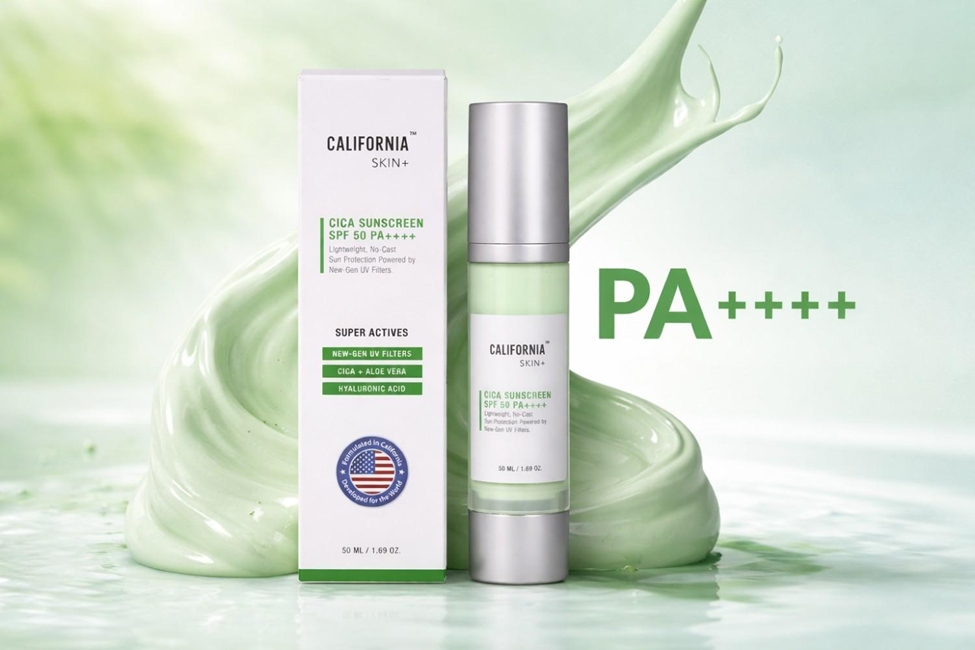
PA++++ sitting next to SPF 50 on a label is the combination that means the sunscreen is addressing both categories of UV radiation seriously. One without the other is an incomplete answer, and for most people it turns out their daily sunscreen has been an incomplete answer for years without them knowing.
The Everyday Application Habits That Quietly Undo Protection
Even when the formula is right, a few very common habits chip away at protection throughout the day in ways that most people do not connect to tanning and pigmentation until someone lays it out clearly.
SPF testing happens at 2mg of product per square centimeter of skin. For the face and neck that means roughly a quarter teaspoon every single morning. Consistent research shows most people apply somewhere between a quarter and half of that. The maths on this is not straightforward either. Applying half the right amount does not mean you are getting SPF 25. Rather, you may only be applying the equivalent (virtually) of about SPF 7 or 8. Consequently, there will be a considerable difference between your perception of how much protection you’re receiving from the product and your actual level of protection due to the incomplete coverage of the product.
What Dry Skin Is Doing to Your Sunscreen Coverage Without You Realizing
The condition of your skin barrier directly determines how well sunscreen products perform because it affects your skin protection throughout the entire day.
The sunscreen application process becomes difficult when the skin barrier suffers damage through excessive exfoliation alongside the use of strong cleansing products and ongoing skin dryness which prevents the skin from regaining its normal condition. The sunscreen effectively covers particular sections of skin. The other areas experience reduced coverage because they either absorb too quickly or create thin patches which allow UV radiation to penetrate through the skin.
People with very dry skin often describe sunscreen feeling like it disappears within an hour, sitting patchily on the surface, or pulling tight after application. The complete sunscreen protection fails to function properly because the barrier shows signs of damage which prevents uniform sunscreen application and skin protection.
Using a deep moisturizer for very dry skin before sunscreen each morning is not just about comfort. It creates a stable even base that sunscreen can actually sit on properly. And there is a real difference between a moisturizer that adds surface hydration temporarily and one that works to restore the actual lipid structure of the barrier. The second kind gives sunscreen something solid and consistent to work from rather than a patchy compromised surface that creates invisible weak spots in your daily protection.
Centella Asiatica Is Doing Something Specific in a Sunscreen Formula
Centella asiatica has earned a lot of attention in skincare over the past several years and the research behind it is more substantive than trend-driven ingredient stories usually are.
The active compounds in centella asiatica including asiaticoside and madecassoside have documented anti-inflammatory and barrier-supporting properties. In sunscreen specifically these matter more than in most other product categories. The skin develops an inflammatory reaction when exposed to ultraviolet radiation because this process occurs even during times of the day when people do not experience visible skin burning. The daily existence of mild skin inflammation establishes a crucial link between skin condition and excessive melanin production which results in tanning and skin darkening that people try to prevent through sun protection methods.
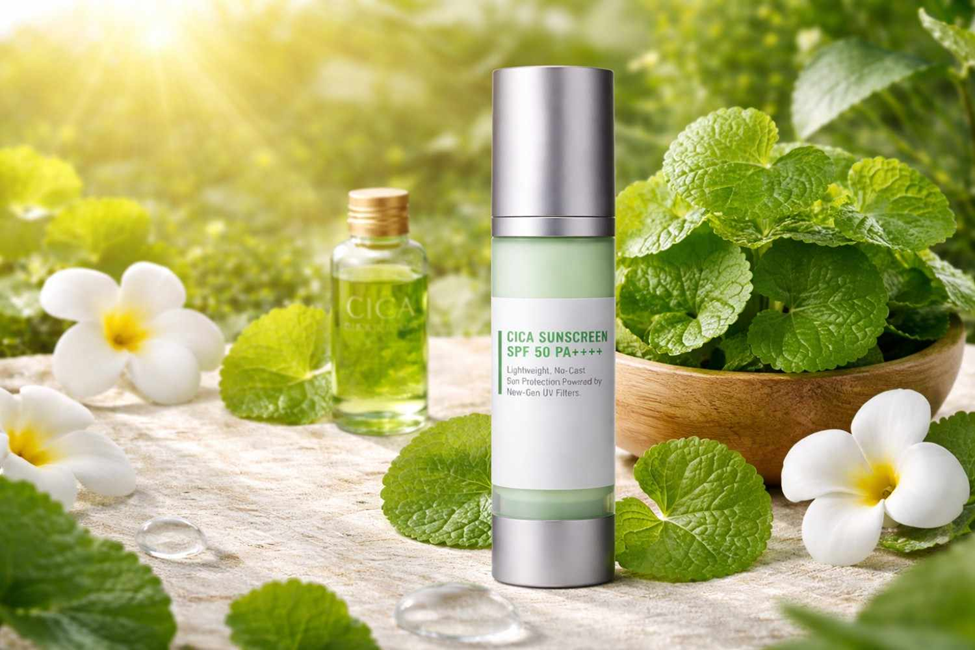
A sunscreen formulated with centella asiatica addresses UV blocking and inflammation calming simultaneously. The combination of both functions in one morning product provides a practical advantage for people with reactive or sensitive skin who have existing hyperpigmentation because it shows visible improvements in their skin condition throughout the day.
The Trade-Off Acne-Prone Skin Has Been Accepting Without Needing To
People managing active breakouts have historically treated sunscreen as something that comes with a cost. A lot of sunscreen formulas are comedogenic enough that wearing them daily produces new congestion reliably, so the choice felt like tan and pigmented or clear and breaking out. Neither of those options is acceptable when both problems are already frustrating enough on their own.
The answer was never choosing between the two. It was finding a non-comedogenic formula and pairing it with a cleanser that removes sunscreen residue properly every evening.
An oil free acne wash at night during months of daily SPF use solves something specific. The residue of sunscreen that is left in pores overnight can create a constant source of new clogs when it comes to the next day. A cleanser that can remove oil and debris without stripping the skin can remove this residue properly.
The trade-off between sun protection and clear skin was never actually necessary. It was a formula problem all along.
What Getting Full Protection Actually Looks Like Day to Day
None of this requires a complicated overhaul of a morning routine. It requires a few specific adjustments done without cutting corners.
- Use a full quarter teaspoon for the face and neck every single morning
- Apply sunscreen last after moisturizer has absorbed and give it fifteen minutes before going outside
- Reapply every two hours during outdoor time without treating it as optional
- Pay attention to the hairline, around the eyes, the nose sides, and ears every single time
- Check for PA++++ next to SPF 50 because both together is what broad spectrum actually means
- Cleanse properly every evening so sunscreen does not sit in pores overnight
Conclusion
Tanning through SPF 50 makes complete sense once you know that SPF was never measuring UVA protection. The rays responsible for tanning, pigmentation, and the quiet daily damage that accumulates for years without a single sunburn were never part of the SPF equation to begin with.
The fix is a sunscreen that carries both numbers. A cica sunscreen with SPF 50 PA++++ alongside centella asiatica that handles the inflammation UV causes even when everything else goes right. A barrier repair moisturizer underneath so the formula actually sits evenly. An oil free acne wash at night so daily SPF use never becomes the reason your skin keeps breaking out.
SPF 50 always had the potential to work properly. It just needed the right things around it.
Frequently Asked Questions
Why does tanning still happen with SPF 100?
Because SPF mainly measures UVB protection. Tanning is driven by UVA rays, so without strong UVA protection (like PA++++), pigmentation can still develop.
Do you need sunscreen when staying indoors near windows?
Yes. UVA rays pass through glass, and daily exposure from windows can gradually cause tanning and pigmentation over time.
Is centella asiatica suitable for acne-prone skin?
Yes. It is non-comedogenic and helps calm inflammation, making it a good ingredient for breakout-prone and sensitive skin.
What does PA++++ actually indicate?
PA++++ is the highest level of UVA protection. It ensures the sunscreen protects against tanning and long-term skin damage, not just sunburn.
Is California Skin+ sunscreen a good choice for daily use?
Yes. A formula that combines SPF 50 with PA++++ and calming ingredients like centella asiatica provides balanced protection against both UVB and UVA, while also supporting sensitive or acne-prone skin.