At night, your skin is at its best from the time you wake up in the morning until it becomes greasy and irritated with bumps in the evening. While your eyes may be swollen in the morning, they will be normal in the afternoon as oil and shine develop in between. Most products tend to irritate at night. Following a night skincare routine for acne can help your skin repair itself, thereby reducing irritation while you sleep.
Your skin functions according to its own biological schedule. This is known as the circadian rhythm. This is what regulates your energy level and when you sleep. It has two functions: 1) protection during the day and 2) repair at night. Oil production and barrier strength change over the course of a day, from when you wake up to when you go to bed.
The skincare routine provides optimal results at 8 AM but causes discomfort at 8 PM because of its specific formulation. Your daily skin problems will become clear to you when you understand how your skin clock operates. Proper regimen timing will help you maintain healthy skin throughout your entire life because it reduces potential issues.
What Happens to Your Skin in the Morning Hours ( The 8 AM Skin)
In the early hours, your body releases more cortisol. This causes your skin to react to this hormonal shift. The skin surface demonstrates greater tightness, the skin barrier shows increased protection, and the skin maintains its moisture for a longer time than it does during subsequent hours.
The skin shows visible changes every morning because protection fails to stop this process. When you lie horizontal for 8+ hours, your face accumulates fluid. This is the cause of puffy eyes and heavy cheeks. The skin shows a pale and dull appearance through its irregular tonal patterns because blood flow reduces during the initial period after someone wakes from sleep. Skin cells are regenerated throughout the day, and because of this, longer period of time the skin remains visibly tired from being on its surface for such an extended period of time.
A skincare routine needs to show its effectiveness in the morning because users experience discomfort with the products that start at night. The reason for your daily skin issues and breakouts exists within your skin’s natural circadian rhythm. The proper schedule of your skincare routine will help you maintain healthy skin without experiencing future problems.
What Happens to Your Skin at Night (8 PM Skin)
Your skin undergoes specific transformations at 8 AM, which show its distinct characteristics. The body needs sleep to restore its skin during the healing period. This healing period lasts till you wake up. Your body produces higher cortisol levels during early morning hours, which lead to specific skin reactions. The skin surface shows greater tightness while the skin barrier provides better protection, and the skin holds moisture for extended periods compared to subsequent times.
The body performs cell renewal processes during nighttime hours. The skin maintains its fresh appearance because dead cells exit the body while fresh cells establish themselves on the skin surface. The body loses its ability to defend itself against threats because its protective barrier now stands at a lower capacity than it did when the day began. The skin loses more moisture while its outer layer becomes more exposed and decreases in protection.
The change explains two different things that people experience. The first reason products absorb better at night because skin barriers open more while blood circulates, which enables better ingredient absorption. The second reason people experience stronger irritation during nighttime hours. The skin becomes more sensitive to products that feel safe during the day because it retains its gentle nature until nighttime.
The body begins its essential skin repair work during this quiet time, which happens to be the most essential hour for maintaining skin health throughout time.
Oil Production, Sensitivity & Breakouts Across the Day
Your skin exhibits different patterns of behavior throughout the entire day. The oil glands in your body experience gradual increases in their production capacity during the daytime hours. The skin reaches its peak oil production capacity during the afternoon and early evening hours, which leads to T-zone areas appearing shiny at sunset despite morning oil balance.
The development of oil on the skin surface causes people to see their pores as bigger and more obvious. The skin contains a combination of sebum and sweat together with tiny airborne particles, which creates a heavy feeling that makes the skin less smooth. The body experiences increased sensitivity during this period. The body experiences increased sensitivity during this period. Skin defense mechanisms reach their weakest point after sunset, which enables nerve endings to respond more strongly to heat and friction with various products.
The combination of these factors leads to the situation where most people develop new pimples during the evening. The skin exhibits its maximum oil thickness, while pores become blocked, and skin sensitivity develops more strongly than it did during the daytime. Your face exists as two different identities, with “day skin” used for safety purposes and “night skin” dedicating itself to restorative processes.
Expert Insight / Dermatologist Comment
“Dermatologists explain that skin functions according to an internal clock which operates separately from the body’s biological systems. During the day, the skin works to produce its own defense against environmental threats, including, by the way, sunlight, pollution, and moisture. At night, that focus changes. Blood flow increases, cell repair speeds up, and inflammation control becomes more active,” explains a board-certified dermatologist.
“The skin requires nighttime hours to achieve its most effective healing process. Treatments applied in the evening often work better because the barrier is more open and cells are more responsive. In the morning, the goal should shift toward protection. The understanding of this rhythm enables people to select their products at appropriate times, which prevents breakouts and irritation and protects against permanent skin damage.”
(Source: PubMed Central)
How Skin Changes From Morning to Night
| Skin Function | Morning (8 AM) | Night (8 PM) |
| Barrier strength | The surface feels firm and better protected | The barrier relaxes and becomes more open |
| Oil production | Oil is low, and skin looks fresher | Oil builds up, andthe shine becomes more visible |
| Sensitivity | Skin stays calmer and reacts less | Skin feels more delicate and easily irritated |
| Cell repair | Renewal moves slowly through the day | Repair activity becomes faster after sunset |
| Product absorption | Products sit more on the surface | Ingredients sink in more easily and deeply |
How to Adjust Your Skincare Routine by Time of Day
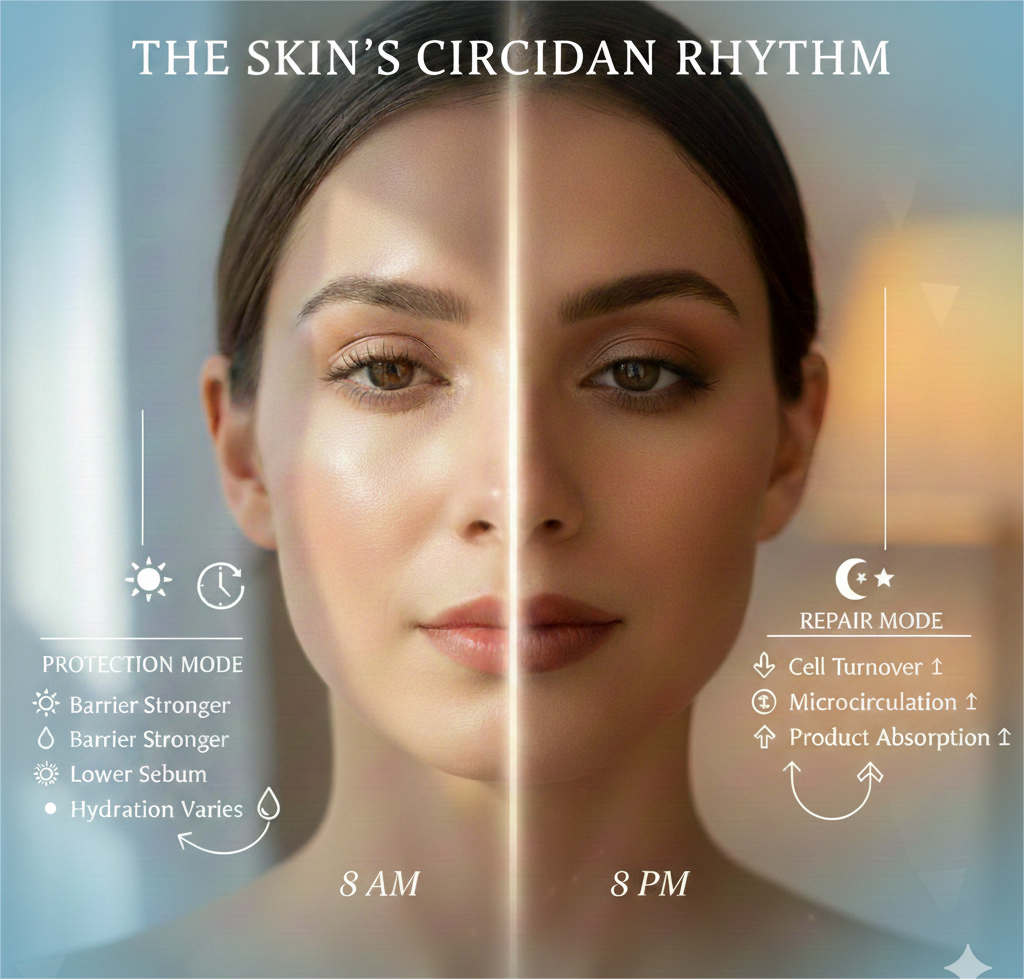
The skin operates according to a timetable, which requires you to establish your daily activities based on this schedule. Your skin needs different treatments at night compared to the specific treatments needed during the day.
Morning Routine Focus
You need to complete two tasks during the morning, which include soft cleansing and strong defense. Begin with a gentle cleanser that removes perspiration and facial oils yet keeps the skin from feeling tight or dry. Strong treatments should not be used at this moment. Your barrier needs protection because it currently operates in its best condition.
The skin requires morning antioxidant serums because these products assist in protecting against ultraviolet radiation, environmental particles, and daily stress. The next step requires applying a lightweight moisturizer that maintains surface hydration without creating an oily appearance. The essential step in this process stands as sunscreen. The skin undergoes gradual damage from sun exposure, which occurs during both cloudy weather and indoor activities.
Night Routine Focus
The purpose of evening care lies in restoring skin health through repair processes. You need to begin your cleansing process with a more thorough method, which will eliminate all traces of makeup, sunscreen, oil, and dirt that have accumulated on your skin throughout the day. Your skin achieves its highest repair abilities at this moment because serums and calming treatments work best during nighttime hours.
The final step of the process requires you to apply a nourishing cream, which will both maintain skin hydration and help with the healing process. The late-night hours cause skin to become more sensitive, which leads people to avoid using aggressive scrubs and powerful acids because these products will produce skin irritation.
Conclusion
Skin does not remain the same from morning to night, and, as such, it is protecting itself against outside pandemics affecting it throughout her life. The body requires nighttime sleep for its healing process because this time period enables the body to mend its wounds and produce fresh cells. The body functions according to its natural daily rhythm, which causes some activities to succeed during specific times while other activities fail during those periods.
The skin shows better results from basic activities when you follow its natural daily rhythm. The practice of adjusting products according to your skin clock will assist in managing oil production, diminishing skin irritation, and promoting long-term skin recovery. The process becomes crucial for those who experience breakouts, dull skin, and uneven skin texture because of their circadian rhythm skin changes. The use of a vitamin C serum in the morning will provide your skin with three benefits, which include protection, brightness, and skin fortification to support its nighttime repair work.
The main factor behind effective skincare practices lies in the timing of product application, not just the selection of products. Your skin will maintain optimal health and balance through the ability to track its natural clock.
FAQs
What is the skin circadian rhythm?
The skin has a daily rhythm that determines when it will defend itself, produce oil, fix injury, and make new skin cells.
Is night really the best time for skincare?
Yes. The body experiences increased blood circulation, which helps to speed up all repair processes during the night. This improvement enables treatments to achieve better results at nighttime.
Why does my skin get oilier by evening?
The body produces more oil throughout the day because oil glands become more active. The skin starts to create additional oil because of the combination of heat, sweat, and stress during the late afternoon hours.
Does poor sleep affect acne and ageing?
Definitely. The body needs sleep to repair itself. Sleep deprivation creates conditions that lead to skin breakouts, which last for longer periods.
Should morning and night routines be different?
The two routines must remain distinct. Morning care focuses on protection, while evening care supports cleansing and repair.
Can circadian rhythm disruption cause sensitive skin?
Yes. The body clock of an individual, when disturbed, leads to two skin problems. The barrier function becomes compromised. The skin becomes more sensitive to both products and environmental elements.